

AIM Online Education - Articles
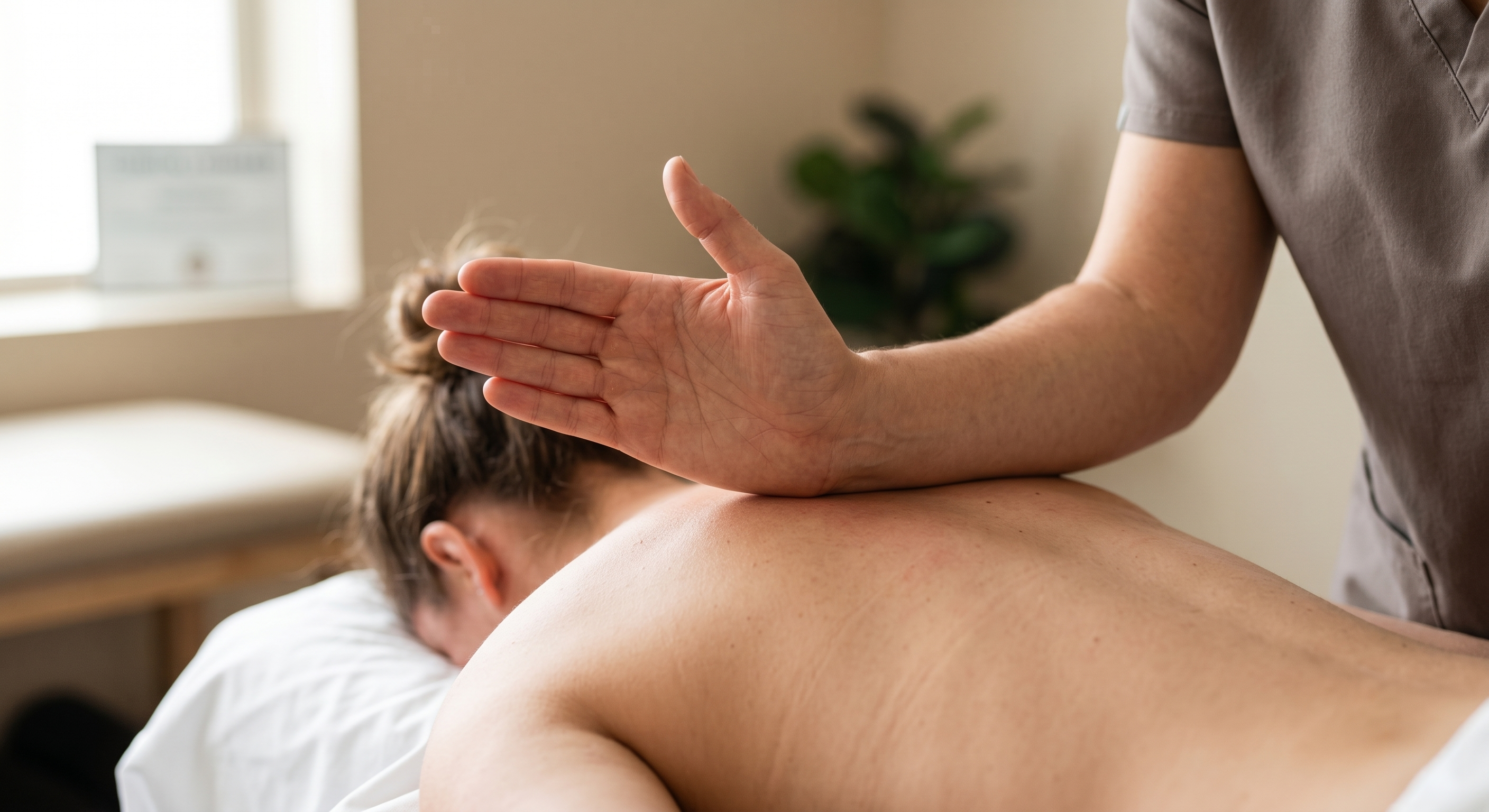
What RMTs Need to Know About Acupressure and Meridian Massage
A client comes in with low back pain. You've done your assessment. Nothing structural is screaming at you. You work the usual suspects — QL, glutes, thoracolumbar fascia — and get decent results, but there's a ceiling. They come back two weeks later and you're back at the same spot.
Most RMTs have been in this situation. You know the tissue. You know the pattern. And yet something in the presentation isn't fully resolving under your hands.
Acupressure and meridian-based approaches are where some practitioners start looking next. What's worth knowing before you do?
What Acupressure Actually Is
Acupressure applies sustained manual pressure to specific anatomical locations — what TCM calls acupoints — along the body's meridian pathways. It doesn't require needles, making it a technique that RMTs can integrate into existing practice without stepping outside scope. The pressure is typically applied with fingers or thumbs, held for varying durations depending on the point and intention.
The meridian framework it draws from is a map of energetic pathways developed over roughly 2,000 years of Chinese medical observation. Twelve primary meridians each correspond to an organ system. From a TCM perspective, pain and dysfunction arise when the flow of qi (vital energy) through these channels is disrupted. The therapeutic goal is to restore that flow.
If you're coming from a Western clinical background, that framing may feel foreign. Fair enough. But the clinical outcomes are worth looking at on their own terms.
What the Research Actually Says
The evidence base for acupressure has grown substantially over the past decade. A 2021 meta-analysis in Evidence-Based Complementary and Alternative Medicine pooled 23 randomized controlled trials with over 2,400 participants and found that acupressure outperformed both tuina massage and physical therapy in low back pain reduction, and was superior to usual care on both pain scores and disability measures (Oswestry Disability Index). The GRADE assessment noted methodological limitations in the underlying trials, so these results should be read with appropriate caution — but the direction is consistent across studies.
A broader systematic review found that acupressure reduced dysmenorrhea, labor pain, chronic headache, and various musculoskeletal complaints across multiple populations. The mechanism isn't fully understood from a biomedical standpoint. Some researchers have proposed connections to neurovascular structures, connective tissue planes, and trigger point distributions. The anatomy isn't settled, but the clinical signal is there.
It's worth being honest about what we don't know. The scientific basis for meridians as discrete anatomical structures hasn't been established. The effects may be mediated through mechanisms we'd recognize in Western physiology — endorphin release, changes in autonomic nervous system tone, local tissue effects — rather than through qi per se. As an RMT integrating these techniques, you don't have to resolve that question. You need to know what the research supports and where its limits are.
Why This Is Relevant for RMTs Specifically
RMTs who train in acupressure aren't switching paradigms. They're adding a layer of precision to work they're already doing.
Think about a practitioner three years into a busy multidisciplinary clinic, seeing eight to ten clients a week with chronic low back pain. Most of them have had imaging, tried physio, maybe done a round of chiropractic. The complaint is familiar but the presentation is stubborn. Soft tissue work helps temporarily. Nothing is sticking.
Incorporating acupoint stimulation along the Bladder meridian — which runs bilaterally down the paraspinal region — gives that practitioner another language for what she's already touching. She's not abandoning assessment or anatomy. She's working with an additional organizational framework that sometimes explains what the orthopedic model doesn't fully account for.
The feedback I hear consistently from RMTs who've gone down this road is that the results aren't magic, but they're sometimes more durable than what soft tissue work alone produces. Clients report a different quality of release. Some things shift that weren't shifting before.
The Meridian Piece
Meridians aren't just about where you press. They're a relational map — each pathway connects to an organ system and runs through predictable regional territory. Working with the meridian framework means understanding which pathways are involved in a given presentation, not just which muscles are tight.
A client with chronic shoulder restriction and digestive complaints might, through a TCM lens, have involvement along the Large Intestine meridian, which runs from the index finger up the arm, through the shoulder, and into the neck. That doesn't mean you ignore the rotator cuff. It means you're working with additional information about why the pattern keeps recurring.
This is where acupressure starts to look less like a technique and more like a diagnostic orientation. You're asking different questions. Where is the restriction in terms of the meridian map? What points are relevant? What's the relationship between the local presentation and the systemic pattern?
What It Takes to Use This Responsibly
Adding acupressure to your practice isn't a weekend decision. The point locations matter. Contraindications matter — certain points are contraindicated during pregnancy, and there are cautions around compromised tissue, recent injury, and specific medical conditions.
More than that, the meridian framework takes time to internalize. It's a different organizational logic than musculoskeletal anatomy. You can learn individual points and get clinical results. But the real depth comes when you start to understand the relationships — why certain points work, why a distal point sometimes affects a region you're not even touching.
If any of this is resonating, it's exactly what we cover in the Acupressure and Meridian Massage course at AIM. Not just the point locations, but the reasoning behind them — the theory, the clinical application, and the integration with work you're already doing. You can find it at [link].
References
Li, T., Li, X., Huang, F., Tian, Q., Fan, Z.Y., & Wu, S. (2021). Clinical Efficacy and Safety of Acupressure on Low Back Pain: A Systematic Review and Meta-Analysis. Evidence-Based Complementary and Alternative Medicine, 2021, 8862399. https://doi.org/10.1155/2021/8862399
Hsieh, L.L., Kuo, C.H., Lee, L.H., Yen, A.M., Chien, K.L., & Chen, T.H. (2006). Treatment of low back pain by acupressure and physical therapy: randomised controlled trial. BMJ, 332(7543), 696–700. [Please verify this citation before publishing.]
Ernst, E. (2010). Acupressure: An Overview of Systematic Reviews. Journal of Pain and Symptom Management, 40(6), e3–e7. https://doi.org/10.1016/j.jpainsymman.2010.09.001
Jung, G.S., Choi, I.R., Kang, H.Y., & Choi, E.Y. (2017). Effects of Meridian Acupressure Massage on Body Composition, Edema, Stress, and Fatigue in Postpartum Women. Journal of Alternative and Complementary Medicine, 23(10), 787–797. https://doi.org/10.1089/acm.2016.0362

Programs
About Us
Contact Us
Our Brands



Programs
About Us
